In many cases, the facility manager receives two or three offers from different guarding companies. The offers look similar on the surface: headcount, working hours, and monthly cost. The manager picks the cheapest — or the one from a company they have heard of — and signs. Months later the problems begin: frequent absences, undertrained guards, reports that never arrive, and a supervisor who does not answer calls. The problem was not bad luck — it was the way the offer was evaluated from the start.
Distinguishing a good security offer from a weak one does not require specialized security expertise. It requires knowing the right questions to ask and the terms to look for before signing any contract. This article gives you the practical criteria you need to compare offers and make a decision on a clear basis.
Why price alone is not enough
Price is the first number most facility managers look at when comparing security offers. That is natural — budgets are tight and cost is a real factor. The problem is not looking at price, but using it as the sole criterion.
The cheapest offer may mean one or more of the following: below-market guard salaries (and therefore lower competency and higher turnover), no insurance or weak coverage, no dedicated field supervisor for the site, minimal training with no ongoing development program, and an absence of the administrative system that ensures service continuity.
The practical result: monthly savings offset by higher costs from unmanaged incidents, time consumed by management chasing service problems, and switching providers after a few months to start from scratch with a new one.
A fair comparison starts by fixing the scope of work first — same headcount, same coverage hours, same requirements — then comparing what each offer delivers for that price. The value difference shows in the details, not in the headline figure.
Practical criteria for evaluating a security company's offer

Beyond price, there are six criteria every facility manager should examine before choosing a guarding company:
Licensing and legal status
Any guarding company operating in Egypt must hold a valid license from the Ministry of Interior under Law 86 of 2015. The license is not just a piece of paper — it confirms the company is registered as an Egyptian joint-stock company, subject to regulatory oversight, and meets the legal requirements for the activity. Ask for the license number and its validity date. If the offer hesitates to provide this information — that is an early indicator worth noting.
Supervision structure and field management
A good offer does not stop at listing the number of guards — it explains who supervises them. Ask: is there a primary supervisor dedicated to my site and present on it? How often do they visit daily and weekly? Is there a higher supervisory level monitoring the supervisor's own performance? How is communication handled between supervision and facility management?
The difference here is clear: a company that assigns a dedicated supervisor to your site within a multi-level supervisory structure differs from one that sends a roaming supervisor passing through many sites without focus. The resident supervisor knows the daily site details and handles problems as they occur — the roaming one may not arrive until it is too late.
Training and qualification program
Ask about the existence of a training and qualification program for the guard before they start at your site. The company is not expected to disclose the details of its internal programs — but you have the right to know that the person working at your facility went through a qualification stage before starting, and that there is a site-specific orientation, not just a direct assignment.
The difference shows in performance: a qualified individual knows how to handle unexpected situations, while one who started without any preparation waits for someone to tell them what to do. Asking about the existence of a qualification program — not its details — is a legitimate right for every client.
Site team stability
One indicator you can observe yourself after signing: is the security team at your site stable or does it change frequently? When you see the same faces month after month, it means the company retains its team — and the individual accumulates knowledge of the site's details and work patterns. When faces change every short period, the facility loses this accumulated knowledge and every new guard starts from zero.
Before signing, you can ask about the company's general approach to maintaining site team stability. A company that cares about this aspect will talk about it clearly — because it is a competitive advantage, not a weakness.
The operational plan for the site
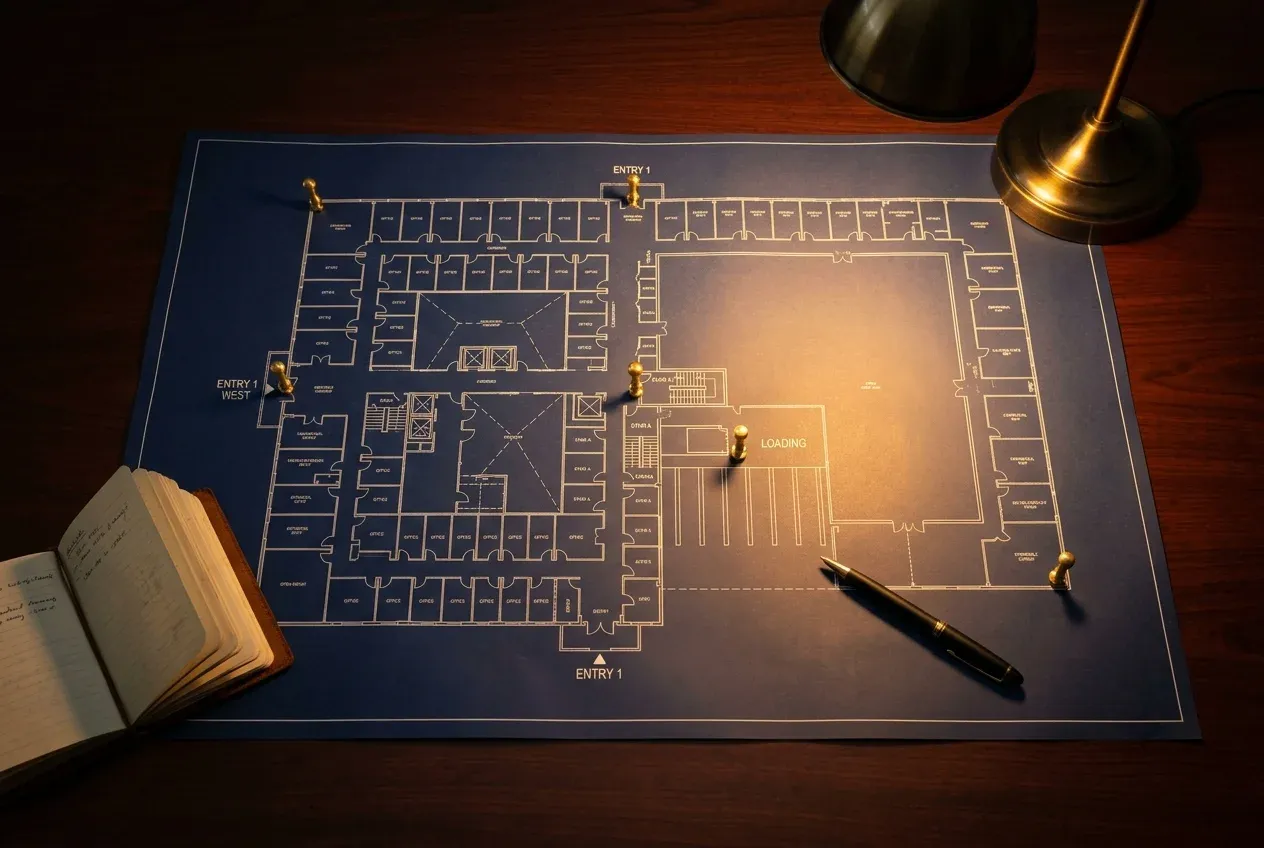
Here the real difference between a serious offer and a superficial one appears. A serious offer does not just send a shift schedule — it includes an operational plan showing where each guard is positioned, what their specific tasks are during each shift, how shift handover is conducted, and what the emergency response protocol is.
The operational plan is the document that transforms a security guard from someone standing at the door into part of a system with clear rules. If you request this document and do not receive it — you are contracting on a promise, not a plan.
Reporting and follow-up system
How will you know what happens at your site? The offer should explain the reporting system: do you receive a daily report? Weekly? Monthly? What does the report include — is it just "no observations" or does it cover patrol details, incidents, and site observations?
Ask the company for a sample of the reports they send to current clients. The report reveals the level of attention to detail. A company that cannot show you a single report template — how will it track its team's performance at your site?