You signed the contract on Sunday. On Tuesday, three security guards arrived at the facility gate. They do not know the names of the entrances, have no written instructions, and do not know who their direct supervisor is. The facility manager asks them: what is your plan? They reply: nobody told us. This is not an exceptional scenario — it is a pattern that repeats in many security contracts that start without a genuine preparation phase.
The gap between signing the contract and the first guard arriving at the site is not just a waiting period — it is the phase where the foundations of the service are built. What happens during this period and the days and weeks that follow determines whether the security system will actually work or remain just guards standing at the gate. This article explains what should happen at each stage — from the moment of signing to the end of the first month.
Between the contract and day one: the preparation phase
The common mistake is that operations begin immediately after signing. In reality, between signing and day one, a series of steps must occur that prevent all the problems that will surface later if skipped.
The detailed field inspection
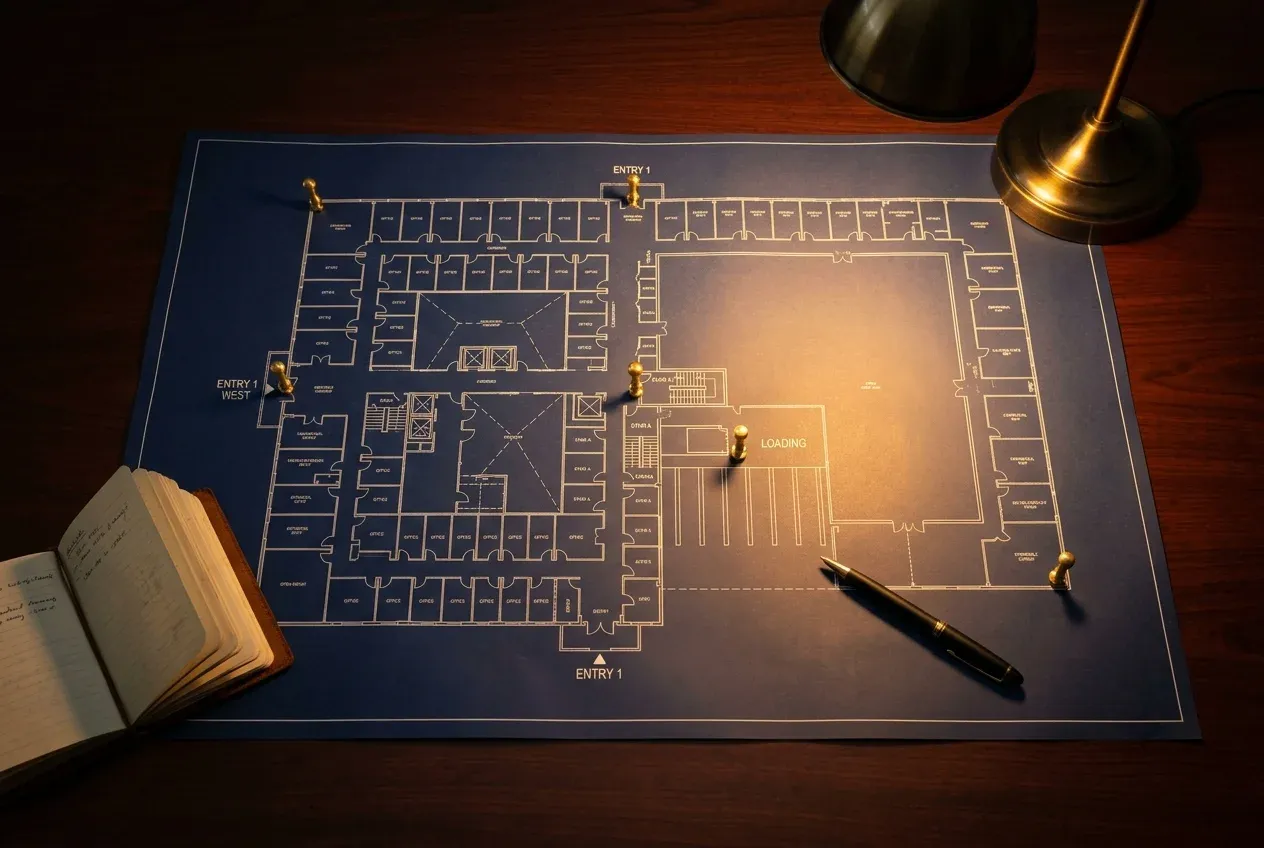
Even if an initial visit was made during the proposal stage, the post-contract inspection is different in nature. This time the goal is not a general estimate but an operational study: how many entrances need actual coverage? Where are the areas difficult to see from fixed positioning points? What are the peak hours for entry and exit movement? Where is the facility team that the security team will interact with daily?
The detailed inspection produces a real map of the site — not in the engineering sense but in the operational sense. A map showing where each guard stands and why, where the patrol passes and at what frequency, and which areas need more attention at specific times.
Writing the operational plan
The operational plan is the document that translates the inspection findings into daily work instructions. For each positioning point there are specific instructions: what the guard monitors, how they handle visitors, what they document, how they hand over the shift, and what the protocol is for unusual situations.
A company that sends guards without a written operational plan leaves each individual to decide on their own what to do. The result: ten guards working in ten different ways, no standard to measure anyone's performance, and no document for the supervisor or facility manager to reference in any dispute.
Preparing the team and orienting them to the site
Before any guard starts work at the site, they must go through an orientation phase. Not general theoretical training — but specific site orientation: the facility's nature and activity, the names of the departments they will interact with inside the building, the details of the operational plan for their position, and the communication channels with the supervisor and facility management.
A guard who arrives at the site understanding its nature acts with confidence from day one. A guard who arrives without any orientation spends the first week trying to understand their surroundings — and during that specific week, most errors occur.
The first week: operations under supervision

The first day at the site is not an ordinary day — it is a test day for everything that was prepared. A disciplined company does not leave its team working alone in the first days. The supervisor is present at the site intensively during the first week to achieve three objectives:
First, ensuring the written operational plan works on the ground. Plans written on paper may face practical obstacles during implementation: a positioning point that turns out not to see the entrance as expected, or a patrol route that conflicts with goods movement at a certain hour. The first week is the opportunity to discover these conflicts and adjust them immediately.
Second, ensuring every guard understands and applies their position's instructions. The difference between a guard who read the instructions and one who actually applies them shows in the details: do they log visitor data in the required format? Do they follow the patrol route or shortcut it? Do they know what to do if they face an unusual situation? The supervisor at this stage observes and guides — they do not wait for an error to punish.
Third, opening a genuine communication channel with facility management. In the first days, the facility manager must know who the responsible supervisor is and how to reach them. Conversely, the supervisor must understand the management's priorities and observations. This early communication prevents small problems from accumulating into major complaints later.
From week two to month's end: stabilization and measurement
After the first week, the site enters the stabilization phase. The team now knows the place, the operational plan has been adjusted based on initial observations, and communication with facility management has taken its natural shape. But this phase is not for relaxation — it is for building the system that will govern work in the coming months.
Adjusting the operational plan
The plan written before operations began was based on inspection and estimation. After two weeks of actual operations, data emerges that was not previously clear: a specific shift needs an additional guard during peak hours, a patrol route needs adjustment to cover an area that proved to be a vulnerability, a positioning point can be merged with another without affecting coverage.
A disciplined company treats the operational plan as a living document that evolves with reality — not a fixed document written once and forgotten.
Starting regular reports
During the first week, reports are intensive and irregular — quick notes and daily adjustments. Starting from the second week, the regular reporting system that will continue throughout the contract should begin: daily reports documenting each shift's events, weekly reports summarizing recurring observations, and a comprehensive monthly report presented to facility management.
The value of reports is not just in recording what happened — but in revealing patterns. An observation that recurs in daily reports for two weeks becomes a problem requiring systematic treatment rather than reactive handling. The first monthly report in particular is an important document — because it presents a realistic picture of the site's security condition after a full month of monitoring and documentation.
The first month report
At the end of the first month, the company should present facility management with a comprehensive report including: a summary of key events and observations, adjustments made to the operational plan and why, the team's compliance level with instructions, and recommendations for the coming period. This report achieves two goals: it gives the facility manager a clear view of what is happening, and it establishes a relationship built on transparency from the start.
A facility that does not receive a report after the first month should ask: is the company actually monitoring its performance or is the service running without oversight?